
The processing of a single bank statement isn’t much of an operational difficulty. In the case of a single PDF file is involved, even manual entry seems feasible.
Divide this task into numerous companies, several account numbers and multiple statement times.
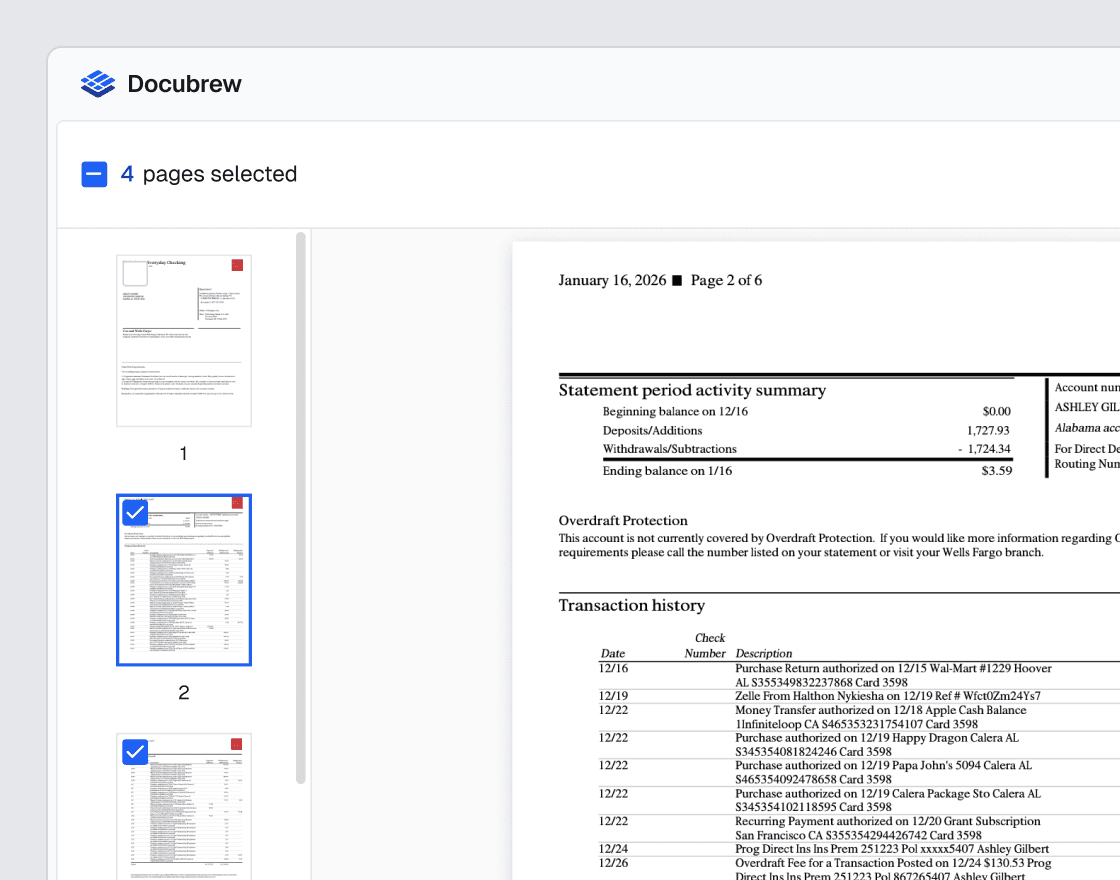
Image credit: docubrew.com
The situation changes. It was once a straightforward job for a clerical worker, but now it’s a tedious workflow which consumes time of staff and increases the chance of inconsistent data entry. It’s not only about improving the conversion speed of bank statements for accounting and bookkeeping companies. It’s about developing a system that works as the amount of documents is increased.
Repetition Is the Real Bottleneck
Take a look at an accounting firm that receives monthly PDFs of multiple clients. One client is Chase one, another Wells Fargo, while others receive statements via Bank of America, Capital One, Citi, or smaller institutions.
Open each PDF file and manually enter each transaction manually.
A converter for bank statements can transform the process from transcription to review. Docubrew extracts transaction figures from the document itself instead of estimating financial values creating structured files which can be inspected prior to use. This difference is becoming more significant when the number of documents grows.
Batch Processing Changes the Equation
For occasional conversions It is possible to deal with files in a separate manner. Accounting firms face different realities. Docubrew permits multiple statements to upload and be processed in one batch, with different results. So, a company can go through a large collection of client documents without manually rebuilding every transaction table.
If the accounting workflow requires CSV files, users can convert bank statements to CSV and review the resulting transaction data before moving forward.
The same is true for papers that have been scanned. Docubrew offers OCR for PDFs scanned. This is a great option for clients who have an assortment of native PDFs and scans in their documents from the past.
Make outputs to support the accounting work in the future.
The conversion doesn’t mean the end of the process. The majority of transactions must be processed.
Docubrew is able to export CSV and Excel. QBO offers an output format for teams that need to transfer bank account statement to Quickbooks.
Businesses that convert bank statement information into Quickbooks regularly may develop a more uniform process around the receipt of the statements, their processing, processing and checking of the data, as well as the creation of the required data files to support the accounting workflow.
Human reviews are crucial. Although automation can cut down on repetitive transcriptions, bookkeepers still have to verify financial data and complete accounting work.
Client data is entitled to its own workflow decision
A higher volume of documents also means that we have to handle more sensitive client information.
Docubrew uses two methods of processing. The Windows desktop application handles conversions locally, which allows files to remain on the company’s computer. Docubrew states that the cloud option can upload documents that are encrypted. Additionally, all transferred and uploaded documents will be deleted in 24 hours.
Accounting practices can choose the most appropriate method for their internal handling requirements.
Scale the process but not the repetitive tasks
A booming bookkeeping business should be expecting more financial documents. It shouldn’t automatically be able to accept additional copy and paste tasks.
It is essential to inquire if the same process that has been successful for five clients could be applied to 50.
Standardizing the method by which statements are received, evaluated and created for accounting software could assist firms in developing a workflow designed to manage the recurring volume of documents, rather than considering each PDF as an individual manual project.